Showing posts with label innovation. Show all posts

Webinar: From Process Understanding to Business Innovation

ebizQ will be hosting a webinar called From Process Understanding to Business Innovation on February 6, 2007 @ 12:00 PM (EST.) Here is a brief description of the event.

Transformation and innovation are the cornerstones of your success. It's no longer enough to be efficient. Business innovation is the name of the game if you want to stay ahead of your global competition. But enhancing customer experiences, increasing operational agility, and re-thinking the way you create value is no easy task. It requires you to change and continually improve your processes.

Tips for end-user acceptance

Any solution, no matter how well it has been conceived will not be successful unless it is embraced by its intended end-users. Here are some quick tips to help promote acceptance (though I don't guarantee it.)

  1. Understand how end-users work: Find out why they do the things they do. If you show an interest in them, they will be more comfortable with what you're trying to accomplish.
  2. Provide opportunities for feedback: This is particularly important when there are user interfaces involved. At regular intervals, let people see the development and direction and be willing to listen to suggestions and feedback.
  3. Manage change: If something has to change let your customer understand the rationale. "Because it has too..." is not a useful response. If the change is meant to make things better explain how.
  4. Make it seem familiar: People by nature are resistant to change. Perhaps there is opportunity to gradually phase in changes (smaller changes are easier to digest) or provide an interface that is similar to an existing one.
  5. Enlist champions: End-users that can teach other end-users are a great way to provide support. It also gives the champions a sense of ownership for the adoption. Early adopters are good individuals to use as champions.
  6. Teach don't point: When someone asks for help one of the worst things you can do is point them to a manual. Spend time to teach them how it works. Show them they're important.
  7. Measure & report: If the new solution is meant to improve productivity, show them the gains that have been made over time as the end-users become more familiar and move up the adoption curve. This type of information shouldn't just be provided to the project sponsors and management.
Projects are usually justified quantitatively based on achieving benefit targets (e.g., gains in efficiency or increases in sales.) Maximum benefits will not be achieved if the end-users do not embrace the solution wholeheartedly.

How "bad" requirements can stifle innovation

A great way to curb innovation and creativity is to impose improper limitations.

Limits by themselves are not bad. Clearly a project needs to operate within a set budget, resource allotment and delivery schedule. These types of constraints can actually spur creativity and novel solutions.

But let's think about business requirements and how improper requirements can hinder the process of innovation. More specifically let's examine how requirements that are not design independent can unfairly constrain a solution to a business opportunity (or problem.)

Many times during my requirements gathering and elicitation engagements I have heard subject matter experts and clients tell me their requirements based on existing applications and functions. They assumed that the products delivering the new capabilities they desired would actually be enhancements to the existing applications. In truth, the eventual solution may be based on an existing one (particularly with software products), but this is not always the case.

Suppose our company designs cars. The newest set of requirements for the upcoming model year state the driver has the ability to:

  1. Determine where he / she is (e.g., location) at all times.
  2. Receive driving directions to a user specified address.
  3. Interact with the system through the car's dashboard.
By themselves, these requirements seem fairly benign. Suppose our project advanced to the stage where we are developing a solution to meet these needs. Our team decides that a global positioning system (GPS) is required. Based on the third requirement, it is decided that an on-board system similar to Onstar is appropriate. Implementing this solution requires our company to purchase units of the GPS product and integrate it into our assembly (line) process.

Nothing appears terribly wrong with the proposed solution, but what if the car model in question is marketed to first time car buyers and students (people who want to be sporty but on a budget.) Large scale changes to an assembly line are costly. Acquiring GPS units and integrating them into a car's electronics are expensive. The cost of the new model will increase as a result.

Because of the third requirement we have ignored other solutions that may have been more optimal. Perhaps we could have offered portable GPS systems (e.g., Tomtom's) to people who purchased our vehicles. Our needs would be met in a more cost-effective manner.

The third requirement constrained our innovation and creativity to the point where a more optimal solution was missed. This is how a requirement that is not design independent can stifle innovation and creativity.

Power Within

On September 13, I had the opportunity to attend a Power Within speaking engagement being held in Toronto. The event looked very promising with speakers such as Micheal Eisner, Sir Richard Branson and Tim Sanders taking part. You can see the full details about the session here.

Micheal Eisner's speech on management was very interesting. He spoke about how Disney used inside-the-box thinking to spur creativity and innovation for their entertainment initiatives. This may sound contrary to the outside-the-box paradigm that is prevalent now, but what Mr. Eisner meant was that for a given project you must understand the size of the box (e.g., amount of resources and money you will devote to it) and innovate, manage and be creative within those confines. He used clips from movies such as Who Framed Roger Rabbit, The Lion King, Outrageous Fortune and Pirates of the Caribbean - Dead Man's Chest to illustrate his points. The complexity concerning things one would not give much thought to was astounding. The example shown was the shading on Roger Rabbit's character while a overhead light swung back and forth (the picture is courtesy of Disney via Google.) This was something that was extremely challenging to perform at that time.
Tim Sanders was a former motivational coach at Yahoo! Mr. Sanders was an engaging speaker and talked about what he termed the, "likability factor." The basic premise is that people who are more likable are more prone to succeed versus an equally competent but less likable individual. He reasoning (backed up by lots of research) was as follows:

  • People want to work with individuals they like.
  • People will be more willing to assist someone they like. Such as give them information that will provide an advantage in a negotiation or a business deal.
  • When choosing between two identical proposals, the one from the individual you like more will generally win.
Mr. Sanders pyramid of likability was as follows (I've stated it upside down):
  1. Friendliness - Make people feel welcome and comfortable.
  2. Relevance - Validate commonalities between yourself and others.
  3. Empathy - Understand feelings are facts. Be a good listener. Don't judge or try to fix the problems.
  4. Realness - (At the top of the pyramid) be genuine. When someone is talking to you, give them your complete attention.
The keynote of the event was Sir Richard Branson. I must admit that this part of the event was a little of a letdown. It was run as an interview session with questions from the audience. Mr. Branson has significant charisma, however I did feel he rambled and didn't necessarily answer questions the audience's questions.

The event itself was good on a whole. If you can find a session keynoted by someone like Bill Clinton, I'd definitely say to check it out!

Webinar: Harnessing Emerging Technologies

Here's an interesting webinar, How to Harness Emerging Technologies to Boost the Bottom Line, from Ziff Davis.

Why do innovative companies find benefits from emerging technologies that others overlook? How do their IT teams use new technologies to create products and services and add value for customers? How do they help drive business innovation and keep competitors at bay?
View it on-demand here.

Webinar: Incorporate Real Innovation into Your Company's Business Processes

Below are the details for a 1-hour webinar, sponsored by Ziff-Davis, on innovating a company's business processes. The webinar will occur on July 11, 2006 @ 2:00 p.m. Eastern/11:00 a.m. Pacific. You can sign-up for it here.

Here is the description.

Real innovation, whether it's in technology or business processes, is not just about inventing something new, but rather it requires a conscious investment strategy, and the will to carry it out. As organizations feel the effects of globalization setting in and competition heating up, companies large and small are turning to the diligent application of any number of innovation practices to try and stay ahead. Customer innovation, innovating from the edge, and innovation road maps are all well-meaning efforts to help companies with the innovation process, but without the proper focus and follow through, these efforts could be fruitless and waste employee time and company money. Innovation means little if new products and services never see the light of day. Therefore, innovation by itself is not enough, it requires an investment strategy that puts your company's resources where they count, and a people strategy that aligns those resources with the best skills of all your employees.

Join this live, eSeminar, sponsored by IBM, and hear directly from technology and business process experts on:

  • How to encourage an atmosphere of innovated thinking in your organization
  • How technology advancements can assist an organization in staying on an innovative path
  • Innovative ways to approach customer service to differentiate yourself from your competitors
  • How to put in place the business practices and processes to see innovative ideas through to fruition

The 4 P's plus 1 reloaded

Back in January, I outlined the basic 4 P's of marketing in my post, Marketing basics - the 4 P's. As a recap, the 4 P's (plus 1) of traditional marketing are:

  • Product - The offering be it a physical product, service or combination of the two.
  • Place - The method of distribution (e.g., physical storefront, online.)
  • Promotion - The strategy and messages comprising the communication aspects of marketing the product.
  • Price - The pricing strategy utilized. This includes discounts and product bundling.
  • Positioning (the last P) - How a product or company is perceived in the marketplace.
I came across a post called Marketing Remix, by John Sviokla, that provided a new 4 P's (err... plus 1!) It's an excellent read and demonstrates how marketing is shifting from the traditional view to a newer paradigm. To paraphrase (as well as add some of my own thoughts):
  • Product becomes Personalization - Standardized products are giving way to more customizable offerings composed of physical products and the services associated with them.
  • Place becomes Presence - The main argument on this piece is that there is much more than just a physical storefront. People can augment everything with simple web searches for more information. The main business concern translates to having a presence where people gather their information and make their decisions.
  • Promotion becomes Persuasion - Sending out traditional advertising is a big item in promotion. However, notice the trend towards the proliferation of user reviews (and other social mediums that are not controlled by marketers) for products.
  • Price (static) becomes Price (dynamic) - With the availability of information there is a greater ability to do direct price comparisons between products and retailers. Bundling, in-the-moment discounts and specials mean pricing strategies are more dynamic.
  • Positioning becomes Preference - Preferences can be interpreted based on things a consumer says, through analysis of their past purchases, through analysis of their search (information gathering) behavior and finally from configuration tools that they use (e.g., a design your own car tool from Volkswagen.)

Please go read John Sviokla's post. It's an excellent read for new age marketing.

A breakaway innovation

Time magazine has an interesting article called, A Game For All Ages (by Lev Grossman), which provides a hands-on preview of the new Nintendo Wii video game system. The control system used for this game platform would qualify as revolutionary (see an earlier post Types of innovation) as it incorporates motion sensing technologies into a controller that resembles a remote control (something a lot of us are too familiar with.) It has potential to change the way people play games since a different level of interaction can be used (see the article for details.) Of course, it remains to be seen how well this translates into profit.

In the article, there were two very interesting comments that stuck out to me:

If you are simply listening to requests from the customer, you can satisfy their needs, but you can never surprise them.
It is definitely more difficult to come up with revolutionary ideas. When listening to your customers, you'll hear more along the lines of the tried-and-true with some new bells and whistles. On the otherhand, you can't ignore your customers either.
Cutting-edge design has become more important than cutting-edge technology.
The overall experience of using a product or service is the new paradigm. Simplicity of design and usability are key factors for success and product adoption. Think of why the Apple Ipod has been so much more successful than any of its competitors.

Big and small

Innovations can come in all sizes: big or small. Look at the little innovation square from my post, Types of innovation. They don't have to be earth-shattering or the next big thing. Innovation can be as simple as trying to improve performance and improving the quality of one's life.

Where do you go for inspiration?
To the competition - What do your competitors do? How do they handle the problems you face? How can you improve upon their offerings? Look at the Apple Ipod. Prior to its introduction there were MP3 players already in the marketplace (e.g., the Eiger Labs MPMan F10.) What separated the Ipod from the others was it's ease-of-use, design and quality.

From unrelated companies - Companies in different industries can face similar problems. Learn from their experiences and mistakes.

From within - Think about the unique capabilities of your company. How can you leverage them to obtain more benefit from your investments? Perhaps your organization is a pioneer and has knowledge others do not (unlikely but this can happen)?

By accident - Research scientist Dr. Spence Silver was trying to develop an adhesive. However, his work yielded an adhesive that could be peeled off over and over. Art Fry realized he could use this adhesive to keep his bookmarks from falling out of his books. Hence the 3M Post-it Note was born!

Use something in a different way - Thomas Savery designed a steam engine to pump water out of mine shafts. Charles Parsons later used the same concept for marine vehicle propulsion and as a means to generate electricity.

Inspiration can be found everywhere!

Questions lead to innovation

By nature, people do not like change. They develop comfort with routine, regardless of whether it makes sense or not. It's some sort of inertia.

As a business analyst you will encounter this inertia many times. Where you'll really notice it is when you are trying to redefine a process to be more efficient and realize that the new process is strikingly similar to the old one. When you ask them why the new process looks the same as the old one, you'll hear answers such as:

  • "I don't know."
  • "We've always done it that way."
  • "I'm not sure why we do that; we just do."
  • "Why would I do it anyway else?"

With any process, you should try to understand why you need to do any specific step. What are the key benefits, considerations, safeguards etc...? Are we simply asking for a step in the process because, "it's always been there?"

Be willing to inquire. Of course you'll need to be a little careful to avoid offending people (see my post Asking questions & getting answers.) However, you must understand your clients' wants in order to determine the best ways to achieve it. As a business analyst, you have a few objectives:

  1. Understand your clients' desires.
  2. Communicate the needs so that IT staff can understand them.
  3. Analyze and innovate to make things better. This is where you add additional value to a project. I'm not talking about increasing scope with all of your ideas. I mean, add value to help your clients' maximize the benefits they can realize.

Is there a better way to do something? What can we learn from other industries? What can we learn from other companies? What can we leverage more?

A company's ability to innovate, improve, and learn ties directly to the company's value. (David P. Norton)

Types of innovation

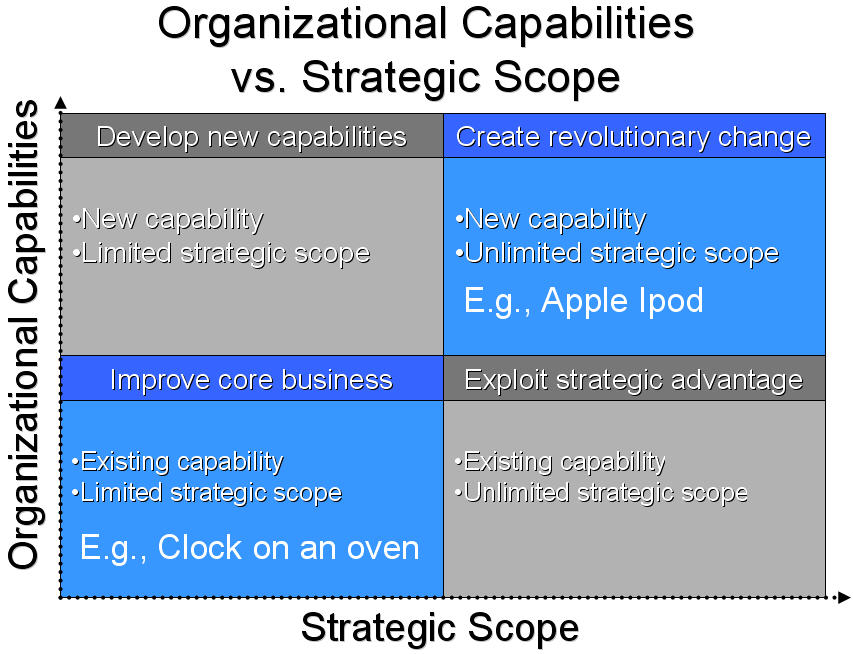
As businesses evolve, innovation becomes increasingly important for companies to survive. The new paradigm is, "The fast eat the slow." When examining the magnitude of an innovation you can use the following chart to categorize the innovation.

  • Improve the core business - Take something that works and add a new wrinkle to it (e.g., add a clock.)
  • Develop new capabilities - Find a new way to do something within an existing marketplace.
  • Exploit strategic advantage - Extend a competitive advantage into a new market (e.g., Nintendo extended their video game systems into the portable video game system market with the Gameboy. Nintendo can no longer claim the top position in the console market however they have the vast majority of the portable market.)
  • Create revolutionary change - Create a new capability for your company and use it to fundamentally change how your company operates and behaves (e.g., The introduction of the Apple Ipod and Itunes. Think of how these two products have changed Apple's business model.)

Some articles of interest for those who like innovation are: